.png)


Change, progress and a Renault 5
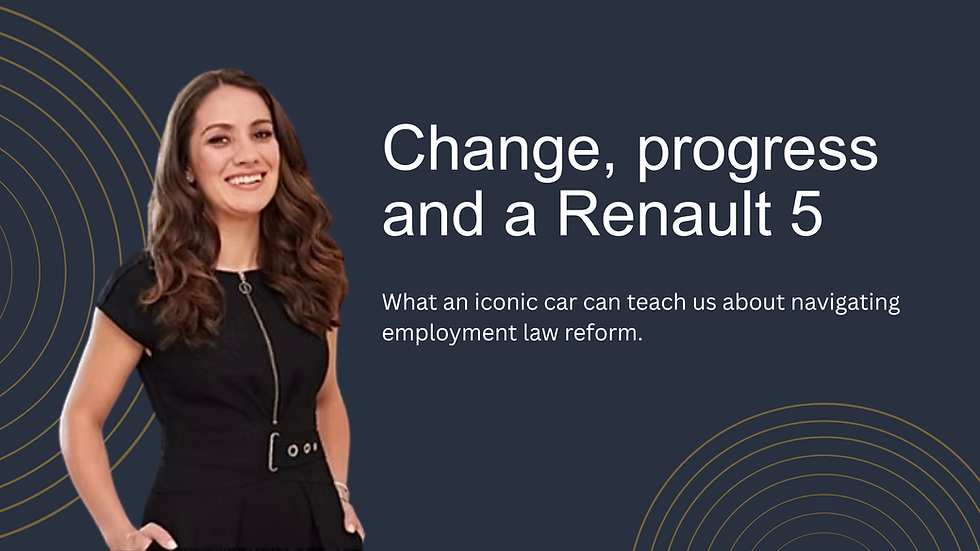
Sarah Buxton reflects on employment law reform, embracing change and why progress doesn't have to mean losing what worked before.
Employment law is changing again - and in a way that feels more significant than many of the incremental reforms we’ve seen over the years.
The Employment Rights Act 2025 is being phased in throughout 2026 and beyond, bringing with it a real shift in the balance between work, security and fairness for individuals. Day‑one rights for key family leave, statutory sick pay from the first day of absence, enhanced protections around redundancy and whistleblowing, and a renewed focus on preventing workplace harassment are no longer abstract policy ideas. They are here, or just around the corner, and they will affect almost every employer and employee in some way.
As employment lawyers, we spend a lot of time helping clients navigate change - often when it feels disruptive, inconvenient or uncomfortable. Change can create uncertainty, and uncertainty can feel risky, particularly in employment relationships where trust and clarity matter so much.
But not all change is bad. Some change is overdue. And some change, when you look back, turns out to be quietly joyful.
That brings me, perhaps unexpectedly, to a Renault 5.
Many years ago, long before electric vehicles, apps or low‑emission zones were part of everyday conversation, I bought myself a used silver Renault 5 for £250. I had saved the money from my part time job working in a shoe shop and I was proud of myself for doing so! It was far from glamorous. It had its quirks, its rattles, and an alarming readiness to remind you of its age on cold mornings. But it was freedom. It represented independence, progress and the start of a new chapter. I loved that little car.
Fast‑forward to now, and I find myself driving the electric Renault 5. Same iconic shape, yellow sporty interior, in-built AI. Completely different experience. Smooth, quiet, efficient - and genuinely joyful to drive. It’s familiar enough to feel reassuring, but changed enough to feel exciting. It’s a reminder that progress doesn’t have to mean losing what worked before; sometimes it means re‑imagining it properly.
That’s how I think about the current changes in employment law.
At their best, these reforms promise a more balanced and modern working environment - one that recognises that flexibility and fairness aren’t opposing forces. For businesses, the challenge is not just legal compliance, but cultural adjustment: reviewing policies, training managers, and making sure day‑one rights don’t become day‑one risks. For employees, the changes offer earlier protection and clearer expectations from the outset of employment relationships.
Of course, with any new framework there will be grey areas, transitional issues and unintended consequences. We are already seeing questions about how day‑one rights sit alongside probationary periods, how increased redundancy penalties affect restructuring decisions, and how far the duty to prevent harassment really extends in practice. These are not theoretical concerns - they are practical, commercial and human.
But just as with my beloved Renault 5, standing still isn’t really an option. Law, like technology, evolves. The key is understanding the direction of travel and moving with it confidently rather than being dragged along reluctantly.
At our firm, we see our role as helping clients make that transition smoothly - keeping what works, updating what doesn’t, and avoiding breakdowns along the way. Employment law isn’t just about rules and risk; it’s about people, relationships and the working lives we all share.
And occasionally, it’s also about appreciating that some changes - whether on the statute book or on the driveway - really can be a pleasure.
If you’d like to talk about how the latest employment law changes affect your organisation, or simply want a practical, plain‑English conversation about what’s coming next, we’d be very happy to help: 0330 088 2275 or email info@buxtoncoates.com


Comments